Introduction 🌿
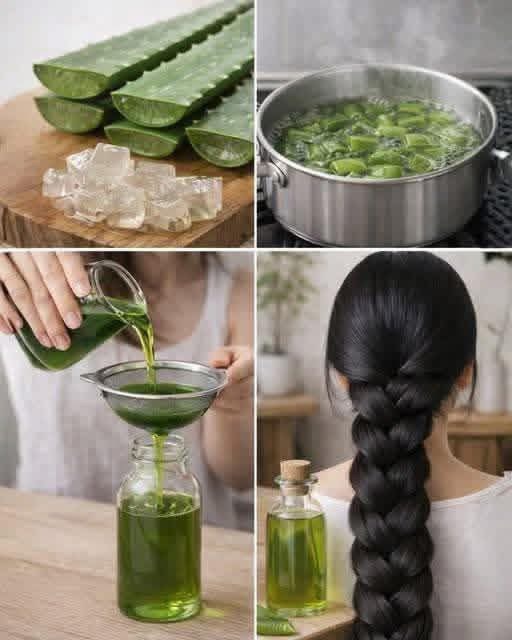
This homemade Aloe Vera Hair Rinse is inspired directly by the preparation shown in the image. Fresh aloe vera leaves are cut into pieces, heated in water, strained, and transferred into a bottle to create a green aloe-based liquid for hair care.
The image also shows a person with long, smooth-looking hair, presenting the preparation as a natural hair-care routine. 🌱✨
Aloe vera is widely used in personal-care preparations, but the image does not provide evidence that this mixture will automatically make hair grow faster or dramatically change hair thickness. It is best described as a traditional aloe-based hair-care preparation, not a guaranteed hair-growth treatment.
Ingredients 🛒🌿
- 🌱 Fresh aloe vera leaves
- 💧 Water
- 🧊 Ice cubes
These are the ingredients visibly shown in the image. No additional ingredients or quantities are added because they were not provided.
Instructions 👩🍳🌿
1. Prepare the Aloe Vera 🌱
Take the fresh aloe vera leaves and prepare them for the recipe. The image shows the leaves cut into smaller pieces before being heated.
2. Add the Aloe to Water 💧🌿
Place the prepared aloe vera pieces into a pot containing water.
3. Heat the Mixture 🔥
The image shows the aloe pieces being heated in a pot of water. Allow the aloe and water to form the green liquid shown in the preparation.
4. Strain the Liquid 🥣🌿
Once the aloe preparation has been heated, carefully strain the liquid to separate the plant pieces from the green liquid.
The image clearly shows the liquid being poured through a strainer into a container. ✨
5. Cool the Preparation 🧊
Allow the prepared liquid to cool. The image also shows ice cubes as part of the preparation, indicating that cooling is an important part of the pictured process.
6. Transfer to a Bottle 🫙🌱
Pour the cooled aloe liquid into a clean bottle or suitable container.
The finished preparation shown in the image is a green liquid stored in a bottle for later use. 🌿💚
7. Apply as a Hair-Care Preparation 💆♀️
The image presents the aloe liquid as a preparation intended for hair care. Use it as part of a simple hair-care routine rather than treating it as a guaranteed hair-growth product.
Methods 🌿✨
🌱 Method 1: Fresh Aloe Preparation
Fresh aloe leaves are the central ingredient. Cutting the leaves into smaller pieces allows them to be incorporated into the water during the heating stage.
🔥 Method 2: Heating
The aloe pieces are placed in water and heated. This creates the green liquid shown in the photograph.
🥣 Method 3: Straining
Straining is an important step because it separates the plant material from the prepared liquid.
This produces a smoother liquid that can be transferred into a bottle. 🌿
🧊 Method 4: Cooling
The preparation is cooled before being stored or used. The photograph specifically shows ice cubes alongside the aloe preparation.
🫙 Method 5: Bottling
After cooling and straining, the liquid is transferred into a bottle. Keeping the preparation in a clean container is important for a homemade liquid preparation.
💆♀️ Method 6: Hair-Care Use
The finished aloe liquid is presented as a hair-care preparation. Aloe-based products are commonly used in cosmetic and personal-care routines, but results can vary from person to person.
History 📜🌿
Aloe vera has a long history of traditional use in different cultures. The plant has been valued for its gel and has been used in various skin-care and personal-care preparations.
Because aloe vera contains a soft, gel-like interior, it has become a familiar ingredient in many homemade beauty preparations. 🌱
Modern cosmetic products also frequently use aloe-derived ingredients in formulations intended for skin and hair care.
The preparation shown here follows a simple traditional-style approach: fresh aloe + water + heating + straining + cooling. 🌿💧
Benefits 🌱💚
🌿 1. Simple Hair-Care Preparation
The recipe provides a straightforward way to prepare an aloe-based liquid for a personal-care routine.
💧 2. Water-Based Preparation
The finished product is a liquid, making it different from thick aloe gel preparations.
🌱 3. Aloe-Based
Aloe is the main botanical ingredient and is commonly associated with personal-care products.
✨ 4. Easy Homemade Process
The pictured method involves only a few basic stages: preparation, heating, straining, cooling, and bottling.
💚 5. Natural-Ingredient Appeal
For people who enjoy homemade botanical preparations, aloe vera offers a familiar plant-based ingredient.
⚠️ Important Hair-Growth Note
The photograph suggests an association between this preparation and beautiful, long hair, but it does not prove that this mixture causes hair growth. Hair growth is influenced by many factors, and homemade aloe preparations should not replace medical treatment for significant hair loss or scalp problems.
Formation 🌱💧🫙
The formation of the preparation can be summarized as:
Fresh Aloe Leaves 🌱
↓
Cut Into Pieces 🔪
↓
Add to Water 💧
↓
Heat 🔥
↓
Strain 🥣
↓
Cool 🧊
↓
Bottle 🫙
↓
Aloe Hair-Care Liquid 💚
Each stage contributes to the final preparation.
The aloe pieces are first incorporated into the water, producing the green liquid visible in the photograph. After heating, the mixture is strained to remove the plant pieces. Once cooled, it is transferred into a bottle.
Conclusion 🌿💚
This Homemade Aloe Vera Hair Rinse is a simple plant-based preparation inspired by the image: fresh aloe vera leaves are heated in water, strained, cooled, and stored as a green liquid. 🌱💧🫙
It can be viewed as a traditional-style hair-care preparation rather than a guaranteed treatment for hair growth. The image does not provide exact measurements or scientifically established claims about hair growth, so those details have not been added.
For anyone who enjoys simple homemade botanical preparations, this aloe-based recipe offers a straightforward addition to a personal hair-care routine. 🌿✨
Lovers ❤️🌱
This preparation is especially appealing to lovers of:
🌿 Aloe vera
💚 Plant-based beauty routines
💆♀️ Homemade hair care
🫙 Simple natural preparations
✨ Traditional botanical ingredients
The beauty of this preparation is its simplicity: fresh aloe, water, heat, straining, cooling, and a clean bottle. 🌱💧🧊🫙
Simple ingredients, a simple method, and a fresh aloe-based hair-care preparation. 💚🌿✨