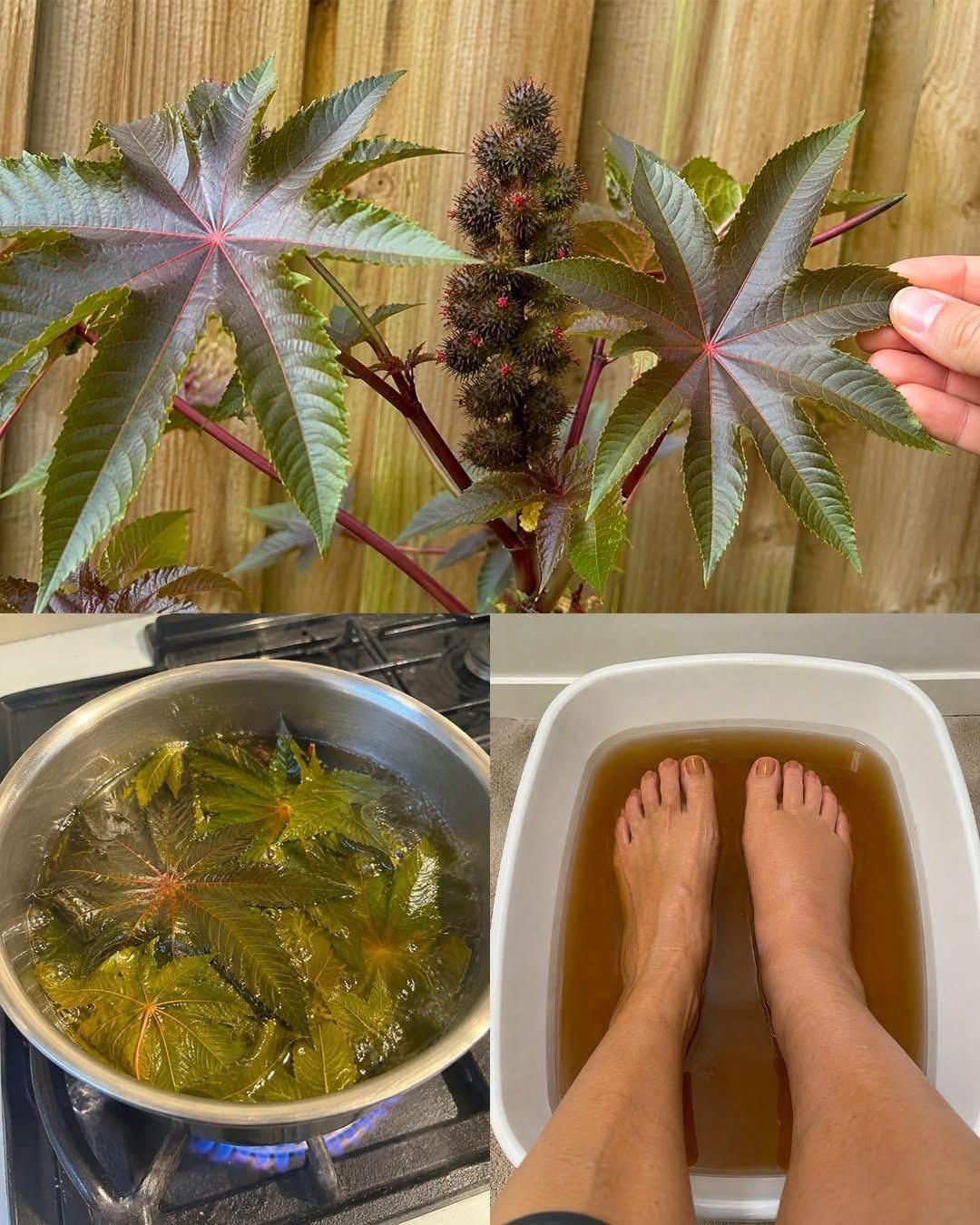
The plant shown in the image appears to be castor bean (Ricinus communis), with its distinctive palmate leaves and spiny seed clusters. The lower images show the leaves being boiled in water and the resulting liquid being used as a foot soak.
Because this is a potentially toxic plant, I would not recommend making or using this foot bath from fresh castor leaves. Castor beans contain the highly toxic compound ricin, and Poison Control specifically advises against using castor beans as a health remedy.
So rather than presenting the pictured preparation as a safe medicinal recipe, here is a detailed, accurate description of what the image shows and the important safety information.
Introduction 🌿🦶
The photograph presents a traditional-looking preparation in which castor leaves are placed in water and heated, producing a brownish-green liquid. The liquid is then transferred to a basin, where the feet are soaked.
The image appears to present this as a natural foot-care remedy. However, there is not enough evidence in the image to establish that the preparation provides a particular medical benefit.
More importantly, because the plant is castor bean, it should not be treated like an ordinary herbal foot-soak ingredient. 🌿⚠️
Ingredients 🌿💧
The image shows:
- 🌿 Castor leaves
- 💧 Water
No exact quantities are provided in the photograph.
⚠️ Safety: I do not recommend using these ingredients to prepare a foot soak. Castor bean is listed among poisonous plants by Poison Control, and its seeds contain ricin.
Instructions 👣⚠️
Because of the plant involved, I would not give step-by-step instructions for preparing and applying this castor-leaf soak.
The photograph itself shows the following sequence:
- 🌿 Castor leaves are collected.
- 💧 The leaves are placed in water.
- 🔥 The water is heated with the leaves.
- 🥣 The resulting liquid is transferred to another container.
- 🦶 The feet are placed into the liquid.
This describes what is shown in the photograph; it is not a recommendation to reproduce the procedure.
Methods 🌿🔥
🌿 Method Shown in the Image
The pictured method involves heating plant leaves in water and then using the resulting liquid as a foot bath.
⚠️ Why This Method Should Be Avoided
The fact that a plant is boiled does not automatically make a homemade preparation safe. Castor bean is a poisonous plant, and the CDC identifies ricin as a natural poison associated with castor beans.
The safest approach is therefore not to prepare a castor-leaf foot soak at home.
🦶 Safer Foot-Care Approach
For a simple foot soak, use ingredients specifically intended for topical use and follow their product directions rather than experimenting with unidentified or potentially poisonous plants.
History 📜🌿
Castor bean, Ricinus communis, is a plant found in tropical and subtropical regions and is well known for its seeds, which are used industrially to produce castor oil.
The plant has also appeared in traditional practices in different cultures. However, traditional use does not by itself establish that a preparation is safe or medically effective.
The major safety concern is the plant’s seeds: castor beans contain ricin, a highly toxic compound. Poison Control notes that ricin is released when the seeds are crushed or chewed.
Benefits 🌿💚
The photograph appears to imply benefits from soaking the feet in the boiled leaves, but specific therapeutic benefits cannot be established from the image.
It would therefore be misleading to claim that this preparation:
- ❌ Treats diabetes
- ❌ Removes toxins from the body
- ❌ Treats infections
- ❌ Cures swelling
- ❌ Treats nerve problems
- ❌ Cures joint disease
- ❌ Provides a guaranteed medical benefit
A natural-looking preparation is not necessarily a safe preparation. 🌿⚠️
Formation 🌿💧
The pictured preparation can visually be described as:
Castor Leaves 🌿
↓
Water 💧
↓
Heating 🔥
↓
Dark Herbal Liquid 🥣
↓
Foot Bath 🦶
However, this formation should be regarded as a description of the image rather than a recommended home remedy.
Important Safety Information ⚠️🚨
Castor beans contain ricin, a potent toxin. The CDC states that ricin can cause serious poisoning depending on the route and amount of exposure.
Poison Control also specifically says never to attempt to use castor beans as a health remedy.
If someone has already used a castor-plant preparation on their skin and develops irritation or other concerning symptoms, wash the exposed area and seek appropriate medical or poison-control advice. If castor beans or seeds were swallowed, seek poison-exposure advice promptly rather than waiting for symptoms.
Conclusion 🌿🦶❤️
The image shows a castor-leaf foot soak, but this is one of those situations where a natural remedy should not automatically be considered safe.
The plant appears to be Ricinus communis, and its seeds contain the potent toxin ricin. Because of that safety concern, I would not recommend preparing or using the pictured castor-leaf bath as a home remedy. 🌿⚠️
A safer approach is to choose a foot-soak ingredient that is specifically established for topical use rather than experimenting with potentially poisonous plants.
Lovers ❤️🌿
For lovers of traditional herbal preparations, this image is certainly interesting from a botanical and cultural perspective. 🌿📜
But when it comes to homemade remedies, natural does not always mean safe. ❤️⚠️
Learn about the plant first 🌿, check its safety 🛡️, and only then consider whether it belongs in a home remedy.🦶💚